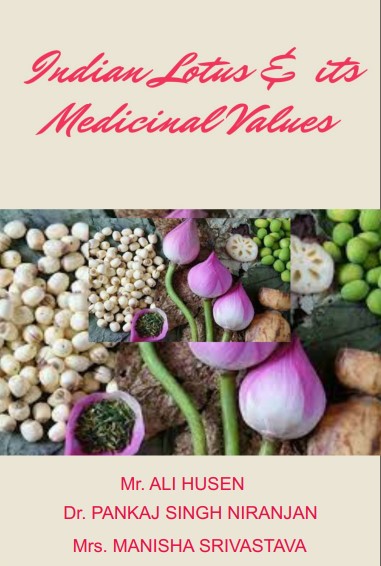
Description
Nymphaea lotus is used by rural and tribal population in our country for various problems like dysentery, diarrhea, sinusitis, headache, tonsil etc. the demonstration of antimicrobial activity of this plant against both gram-negative and gram positive bacteria was an indication that the plant is a potential source for production of drugs with a broad spectrum of activity and this also supports the traditional application of the plant and suggests that the plant extracts possess compounds with antibacterial properties that can be used as antibacterial agents in novel drugs for the treatment of wound infections.
The dried leaves were extracted in ethanol study phytoconstitutes present in them using thin layer chromatography. For thin layer chromatography, glass plates and precoated silica gel sheets were used. When visualized under iodine, maximum five spots were observed in thin layer chromatographic glass plate coated with silica gel G for TLC with the leaf extracted in ethanol the developing solvent systems are different. Ethyl acetate: Methanol: Water (10:2:1) was used as developing solvent of thin layer chromatography on glass plate coated with silica gel G for TLC with the leaf extracted in ethanol when five spots were observed. Similarly, Benzene: Chloroform (1:1), Petroleum ether: Ethyl acetate: Methanol (17:2:1) and Xylene: Chloroform (1:1) were the developing solvents of thin layer chromatography on glass plate coated with silica gel G for TLC with the leaf extracted in dichloromethane when five spots were observed. With these solvent systems maximum number of compounds can be isolated using thin layer chromatography. For thin layer chromatography of leaf extracted in dichloromethane with precoated silica gel sheets under ammonia solution as visualizing reagent maximum six spots were observed with solvent systems Petroleum ether: Ethyl acetate: Methanol (17:2:1) . Therefore, it can be inferred that it is preferred over ethanol to extract more compounds from dried leaves of Lotus.
The in vitro antimicrobial activity of ethanolic extract of N. lotus leaves against the microorganisms employed was assessed qualitatively and quantitatively by the presence or absence of inhibition zones and zone diameters. The ethanolic extract of N. lotus showed in vitro antimicrobial activities against tested microorganisms (S. aureus, S. pyogenes, E. coli, K. pneumoniae and P. aeruginosa). In this study, the antimicrobial activities of ethanol extract were compared with standard streptomycin and this wasused as positive control. Results from the antimicrobial disc diffusion assays were s. The data indicated that S. aureus, Streptococcus spp and E. coli were the most sensitive bacteria tested to the ethanolic extracts of N. lotus with the highest inhibition zone of 25, 20 and 25 mm respectively.
The P. aureginosa and K. pneumoniae were also found to be sensitive with the highest inhibition zones of 15 mm respectively. The ethanolic extracts of N. lotus also showed excellent activity against tested gram-positive bacteria. E. coli was the most sensitive organism among gram-negative bacteria with the inhibition zone of 25 mm which was even more than that of standard streptomycin which was 20 mm. From the results obtained it was apparent that the ethanolic extract of N. lotus at 40 mg/ml concentration was the most effective as widest inhibitory zone were observed compared to other concentrations used. Phytochemical screening of ethanolic extract of N. lotus shows the presence of anthraquinones, cardiac glycosides, saponins, tannins, alkaloids, flavonoids and phenolics.

Reviews
There are no reviews yet.